Saddle Soap: What It Is, What It Does, and How to Use It Properly
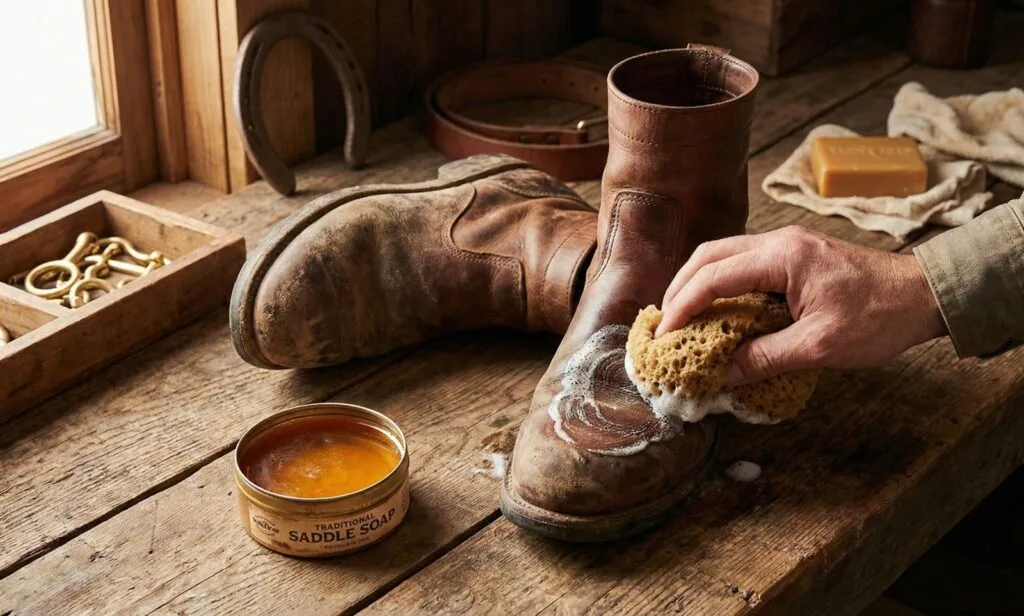
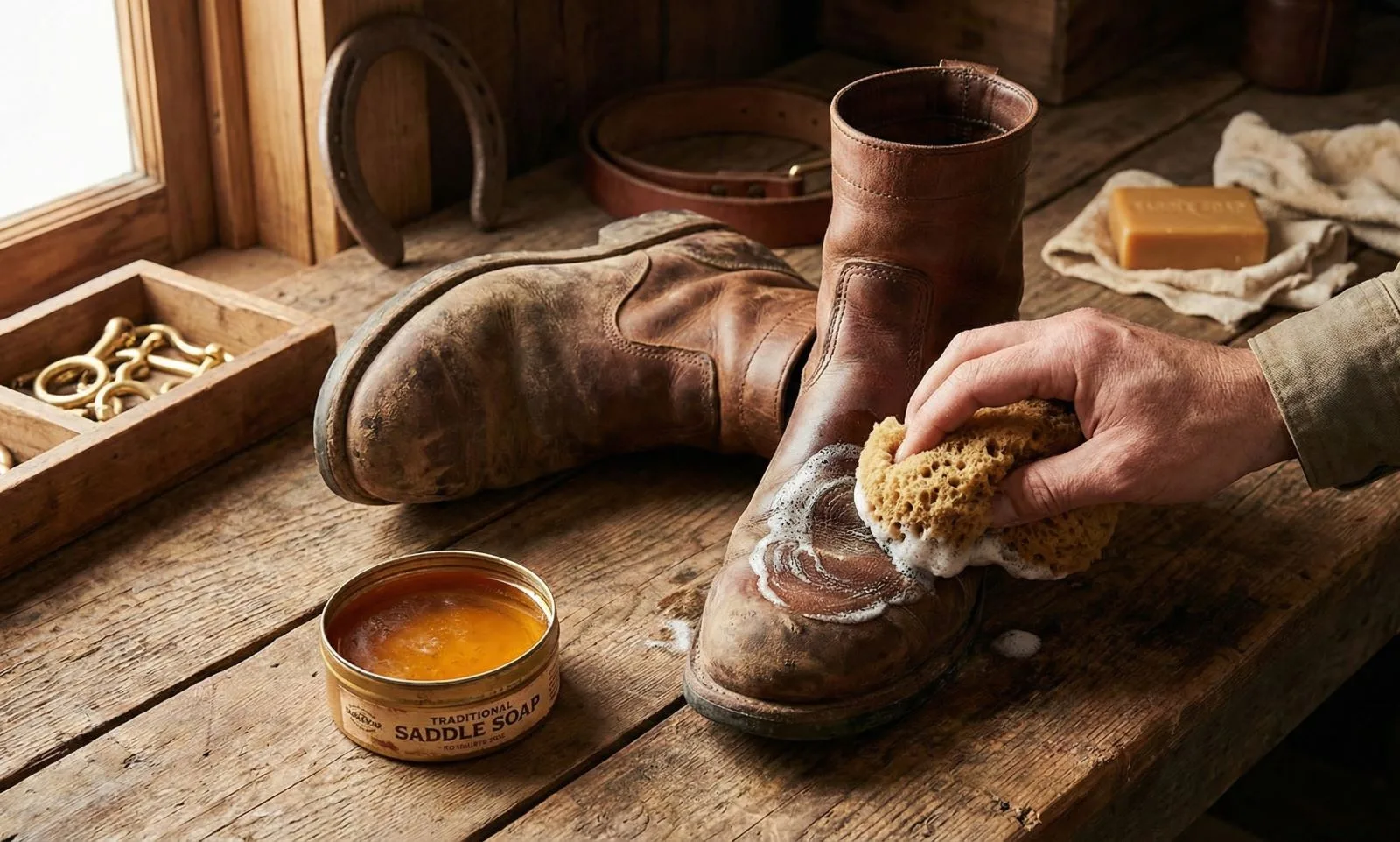
Saddle soap cleans leather by removing dirt, sweat, and old oils while adding a thin wax layer, but it also dries leather slightly, which is why it always requires conditioner afterward.
Saddle soap functions as a cleaning-and-light-conditioning product for durable leathers, and its alkaline soaps, glycerin, lanolin, and waxes produce both benefits and risks depending on leather type and frequency of use.
What Is Saddle Soap?
Saddle soap is a leather-cleaning compound that combines alkaline soaps, glycerin, lanolin, and protective waxes to clean and maintain sturdy leather surfaces. Traditional saddle soap serves heavy-duty leather goods such as saddles, work boots, harnesses, and structured leather bags because its formula removes dirt efficiently while preserving surface integrity.
Saddle soap functions as a cleaner first and a conditioner second. Its soap content breaks down organic grime, sweat salts, and accumulated oils, while its wax content leaves a thin protective finish that enhances surface shine. Because saddle soap contains alkaline surfactants, it affects leather’s natural oils, which is why it remains better suited for finished, full-grain, and vegetable-tanned leathers rather than delicate materials.
Its historical role stems from equestrian gear maintenance, where thick leather required a product strong enough to remove sweat salts while still maintaining flexibility. Modern users apply saddle soap to boots, belts, structured bags, holsters, and tack equipment, prioritizing items that benefit from deeper cleaning.
Saddle soap differs from pH-balanced leather cleaners because saddle soap removes more oil and dirt, while balanced cleaners focus on gentle preservation. This distinction explains why saddle soap always pairs with leather conditioner to replenish moisture lost during cleaning.
What Is Saddle Soap Made Of?
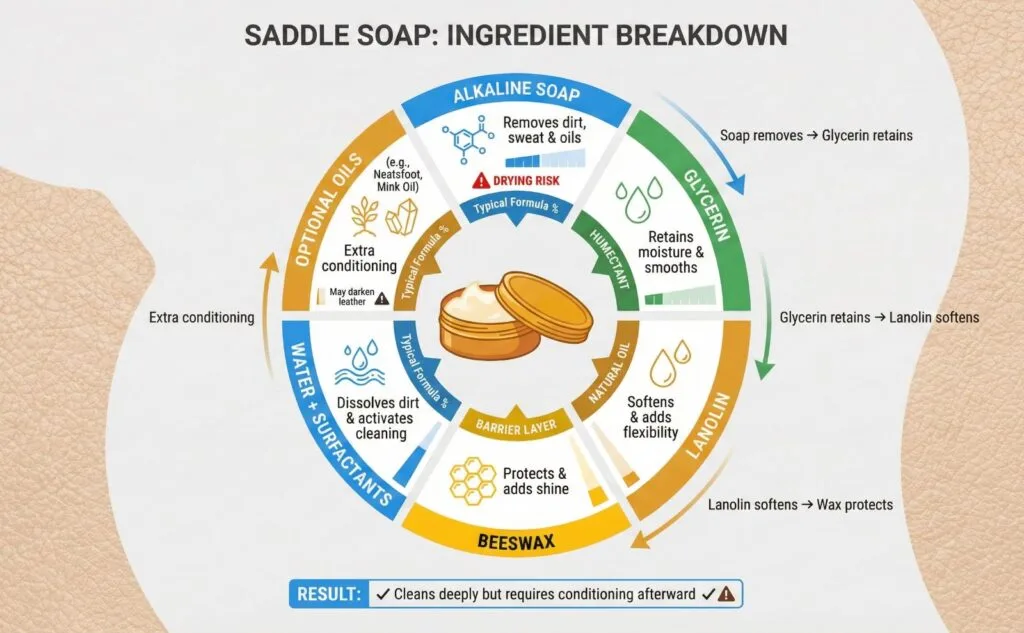
Saddle soap contains alkaline soaps, glycerin, lanolin, beeswax, water, and optional oils, and each ingredient performs a specific function that affects leather strength, moisture, and finish. Its ingredient balance determines cleaning power, conditioning depth, and the risk of over-drying.
1. Alkaline Soap (Cleaning Agent)
Alkaline soap removes dirt, sweat salts, and old oils by breaking down fatty residues on the leather surface. Because alkaline soap strips natural oils, leather experiences moisture loss, which is why saddle soap always requires follow-up conditioning. Higher alkalinity increases cleaning strength but increases drying risk.
2. Glycerin (Humectant)
Glycerin attracts and retains moisture inside leather fibers. Glycerin reduces the drying effect of the alkaline soap portion and improves surface smoothness. Glycerin-heavy formulas work well for boots, belts, and tack that need frequent cleaning.
3. Lanolin (Softening Oil)
Lanolin penetrates leather fibers and restores flexibility and suppleness. Lanolin offsets some moisture loss caused by soap and supports long-term softness. Lanolin-rich formulas benefit stiff full-grain leather and reduce friction cracks.
4. Beeswax and Synthetic Waxes (Protective Layer)
Beeswax forms a thin, semi-water-resistant barrier that shields leather from surface moisture and light abrasion. Wax-heavy formulas enhance shine and tactile smoothness but may slightly darken lighter leathers. Waxes also reduce future dirt adhesion.
5. Water + Surfactants (Solvent System)
Water dissolves dirt and activates the soap, while surfactants lift grime from pores. Surfactants determine lather quality. Strong surfactants increase cleaning intensity but accelerate moisture removal.
6. Optional Oils (Conditioning Additives)
Some formulas use neatsfoot oil, mineral oil, or plant oils for extra conditioning. These oils supplement lanolin to improve softness, but excessive oil concentration may darken full-grain leather.
Ingredient Impact Analysis
| Ingredient | Function | Benefit | Risk |
|---|---|---|---|
| Alkaline Soap | Cleans | Removes dirt and oils | Drying |
| Glycerin | Moisturizes | Retains moisture | Minimal |
| Lanolin | Softens | Adds suppleness | Mild darkening |
| Beeswax | Protects | Adds shine and barrier | Finish buildup |
| Surfactants | Lift grime | Efficient cleaning | Stronger stripping |
| Optional Oils | Condition | Extra softness | Color change |
Because its ingredients remove as much as they restore, saddle soap operates as a cleaner with light conditioning ability, not as a full conditioner.
Exactly What Does Saddle Soap Do?
Saddle soap cleans, degreases, conditions lightly, and protects leather by combining alkaline soaps, glycerin, lanolin, and waxes into a single cleaning compound. Its chemistry produces multiple effects at once, and each effect influences leather moisture, softness, and finish.
1. It Removes Dirt, Grime, and Sweat Salts
Alkaline soaps dissolve organic dirt, perspiration salts, mud, and surface oils. This cleaning action provides a deeper clean than mild pH-balanced leather cleaners. Heavy boots, saddles, and tack accumulate salt and grime rapidly, and saddle soap removes these deposits efficiently.
2. It Removes Old Oils and Surface Buildup
Because saddle soap lifts fatty residues and embedded oils, it clears away wax buildup, body oils, and conditioner remnants. This removal prepares leather for fresh conditioning, ensuring new oils penetrate evenly.
3. It Provides Light Conditioning
Glycerin and lanolin supply limited moisture and softening, preventing the leather from stiffening after cleaning. These ingredients help maintain pliability, but they cannot replace the deeper hydration produced by dedicated conditioners.
4. It Adds a Temporary Protective Layer
Beeswax and synthetic waxes leave a thin protective film that increases water resistance and reduces friction scuffs. This film improves surface shine but does not replace waterproofing treatments or long-term conditioners.
5. It Can Dry Out Leather if Overused
Alkaline soaps extract natural oils, which causes drying when saddle soap is used frequently. Overuse can produce stiffness, micro-cracks, and color dullness, especially on lightly finished leather. Correct usage limits saddle soap to 1–3 cleanings per year, with conditioning immediately afterward.
6. It Smooths Minor Scuffs
Because waxes fill shallow abrasions, saddle soap visually reduces light scuffs and surface scratches, improving cosmetic appearance.
What If My Leather Good Gets Wet?
Wet leather must dry naturally before any saddle soap is applied because saturated fibers lose structural strength when exposed to soap and friction. Water weakens collagen bonds, and saddle soap accelerates moisture loss, which increases stiffness, warping, and finish damage.
Why Saddle Soap Should Not Be Used on Wet Leather
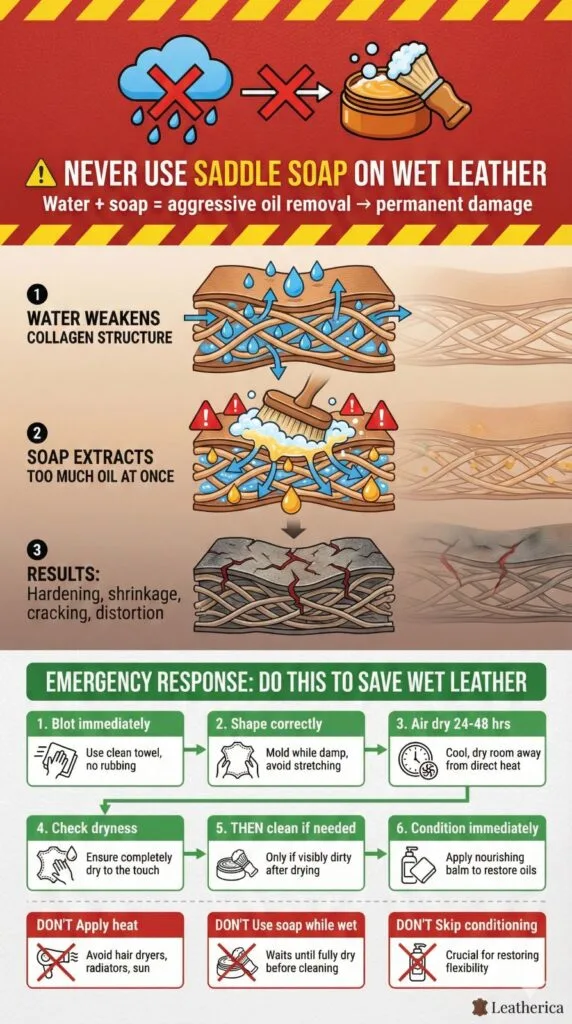
Alkaline soap extracts oils aggressively when leather fibers are waterlogged. Saturated leather cannot regulate oil movement, so saddle soap removes too much oil at once, which produces:
- Hardening
- Shrinkage
- Surface cracking
- Finish dulling
- Permanent distortion in structured items
How Wet Leather Behaves
Water disrupts the collagen matrix that gives leather strength. When fibers swell, the material becomes vulnerable to friction, pressure, and soap. Wet leather stretches out of shape easily.
How to Handle Wet Leather (Step-by-Step)
- Blot moisture immediately
- Shape the item correctly
- Air-dry for 24–48 hours
- Check for stiffness
- Clean with saddle soap only after drying
- Condition immediately
Saddle Soap vs Leather Conditioner
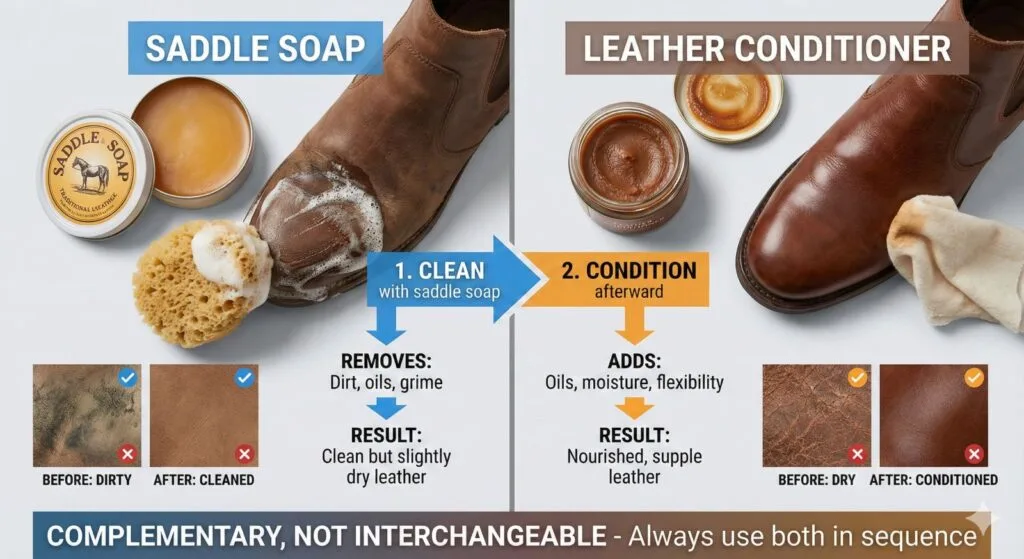
Saddle soap cleans and removes oils, while leather conditioner moisturizes and restores oils, and this opposite functionality makes them complementary rather than interchangeable.
Saddle Soap vs Leather Conditioner
| Attribute | Saddle Soap | Leather Conditioner |
|---|---|---|
| Primary Purpose | Cleaning | Conditioning |
| Removes Oils? | Yes | No |
| Adds Oils? | Minimal | High |
| Moisturizes? | Light | Strong |
| Risk | Over-drying | Over-softening |
| Use Order | First | After |
Saddle soap prepares the grain by removing grime, and conditioner restores the oils stripped during cleaning.
Is Saddle Soap Like Mink Oil?
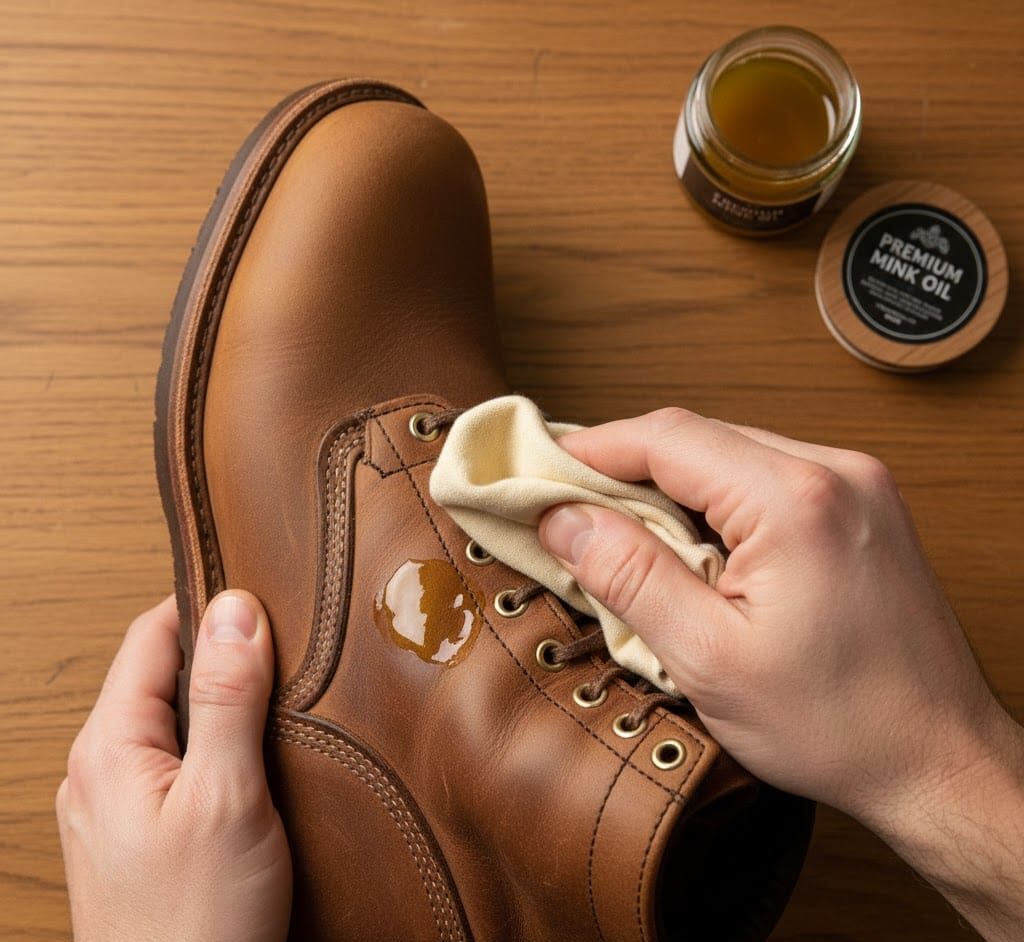
Saddle soap removes oils, and mink oil adds oils, so they serve opposite purposes. Saddle soap cleans; mink oil conditions deeply.
Key Differences
| Attribute | Saddle Soap | Mink Oil |
|---|---|---|
| Category | Cleaner | Conditioner |
| Penetration Depth | Low | High |
| pH Impact | Alkaline | Neutral |
| Color Effect | Slight dulling | Noticeable darkening |
| Use Order | First | After cleaning |
Correct sequence: clean → then condition.
How to Use Saddle Soap (Step-by-Step)
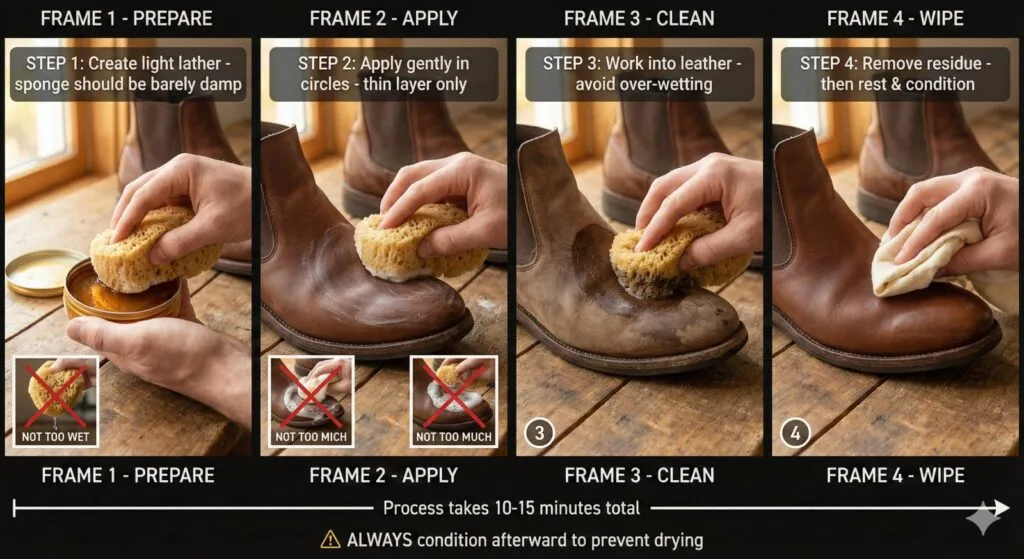
Saddle soap cleans effectively only when applied with minimal moisture and followed by immediate conditioning.
Steps
- Remove dust
- Create light lather
- Apply gently
- Avoid over-wetting
- Wipe residue
- Rest 10–20 minutes
- Condition immediatel
Frequency Guidelines
- 1–3× yearly for boots and belts
- 3–6× yearly for tack
- 0× for suede, nubuck, and unfinished leather
Types of Saddle Soap
Saddle soap varies by glycerin content, lanolin percentage, wax load, and pH.
Main Types
- Glycerin-based → moderate cleaning, low drying
- Lanolin-based → softer leather, mild darkening
- Beeswax-heavy → higher protection, higher buildup risk
- Bars vs creams → bars = stronger cleaning; creams = gentler
pH Table
| Type | Typical pH | Cleaning Strength | Drying Risk |
|---|---|---|---|
| Glycerin | 8–9 | Medium | Low |
| Lanolin | 8 | Medium | Low |
| Wax-heavy | 9–10 | High | Medium |
| Traditional bar | 9–11 | High | High |
| Cream | 7.5–8.5 | Medium-low | Low |
The Benefits of Using Saddle Soap on Leather
- Removes dirt & sweat salts
- Clears old oils and buildup
- Preps leather for conditioning
- Adds mild shine
- Maintains long-term appearance
- Reduces micro-abrasions
Saddle Soap Ingredients (Deep Breakdown)
| Ingredient Category | Function | Benefit | Risk |
|---|---|---|---|
| Alkaline Soaps | Dissolve grime | Strong cleaning | Drying |
| Oils | Soften | Flexibility | Darkening |
| Emulsifiers | Stabilize mixture | Even application | None |
| Waxes | Protect | Shine + resistance | Buildup |
| Water | Solvent | Controlled cleaning | Over-wetting |
| Stabilizers | Preserve texture | Shelf stability | None |
FAQ: Saddle Soap & Leather Care
Best way to clean a leather purse?
A pH-balanced cleaner is best; saddle soap only for heavy grime.
Can saddle soap darken leather?
Yes, slightly—especially on light leather goods.
Is saddle soap safe for all leather types?
No—avoid suede, nubuck, patent, and unfinished.
How often should I use it?
1–3× yearly for most goods.
Does it remove oil stains?
Surface stains only.
Can saddle soap ruin leather?
Yes, if overused or used on the wrong leather.
Does it waterproof leather?
No, only mild resistance.